
Can Synthetic Data Make Cars Smarter and Safer?
Teaching a car to “see” the world is a complex challenge. Every object, shadow, and split-second decision matters, and it’s impractical—and often unsafe—to stage every near-miss or hazardous scenario on real roads. As vehicles become smarter and more automated, the demand for high-quality automotive perception models continues to grow.
Perception models enable vehicles to interpret their surroundings, recognizing a cyclist at night or a car braking suddenly ahead. But developing these models requires vast amounts of data. Collecting and labeling real-world driving data is slow, expensive, and often infeasible, especially for rare or dangerous situations.
The Data Shortcut: Synthetic Environments
To address these limitations, automotive engineers are increasingly turning to synthetic data and simulation. These digital environments generate datasets designed to approximate real-world driving conditions with high fidelity.

With simulation, developers can safely recreate challenging scenarios like nighttime pedestrian crossings, complex intersections, or glare-filled highways in minutes instead of months. At Magna, we use virtual test beds to explore countless “what-if” situations long before a prototype ever hits the track.
Inside the Virtual Test Track
Modern simulation platforms can replicate complete sensor suites—cameras, radar, and lidar—capturing precise ground-truth data for every vehicle, object, and weather condition. By using multi-modal inputs such as RGB images, depth maps, and semantic segmentation, engineers can fine-tune virtual worlds to test specific edge cases and environmental factors.
A key advancement, called synthetic-to-real transfer learning, helps bridge the gap between virtual and real-world driving. By training AI models on both synthetic and real data, we support perception systems in recognizing patterns that remain consistent under real-world variability. This approach has shown improvements in accuracy and robustness during testing compared to traditional methods.
Faster, Safer, Smarter
Synthetic data doesn’t just supplement traditional field testing—it expands what’s possible.
- Shorter development cycles: Months of on-road data collection can be condensed into hours of virtual generation.
- Safer experimentation: Engineers can test extreme situations without risk to people or property.
- Stronger models: Exposure to rare and unpredictable events can improve system performance in real-world conditions.
Simulation enables teams to test more, iterate faster, and learn quicker, accelerating the evolution of vehicle intelligence.
Driving the Next Leap in Automotive AI
The next frontier of vehicle intelligence isn’t just about faster processors or smarter algorithms—it’s about better data. Synthetic data and simulation are redefining how we train automotive perception systems, advancing scalable development approaches that prioritize safety.
By teaching cars in the virtual world before they hit the real one, we’re contributing to safer streets, smarter vehicles, and a smoother path to next-generation mobility.
What do you think? How else could synthetic data shape the future of automotive AI and vehicle safety?
We want to hear from you
Send us your questions, thoughts and inquiries or engage in the conversation on social media.
Related Stories
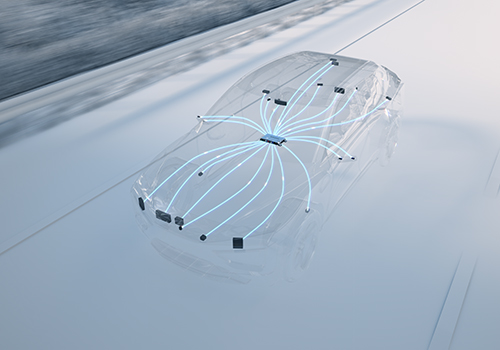
Magna to Offer Drive Hyperion-Compatible ECUs and Tier-1 Integration Services for NVIDIA Drive AV
Releases
Stay connected
You can stay connected with Magna News and Stories through email alerts sent to your inbox in real time.